
It’s 5:30 PM. You announce cheerfully: “Okay sweetie, time to shut off the iPad, dinner is ready!”
Instantly, your sweet, polite 6-year-old transforms. They scream, slam the tablet face-down, burst into inconsolable tears, or throw themselves on the rug yelling that you are “the meanest parent in the entire world.”
Meanwhile, you stand there feeling an uncomfortable mix of anger, exhaustion, and creeping parental guilt. You wonder: Did I ruin their attention span? Are they addicted? Why can't they just put the device down like a normal human being?
The truth is, lecturing, shouting, or grabbing the screen out of their hands almost always makes the battle worse. To fix the daily screen tug-of-war, we first need to understand the biology of what is actually happening in your child's brain—and then replace the power struggle with clear, visual anchors.
The Science: Why Turning Off the Screen Hurts Their Brain
When adults watch a movie or scroll social media, our developed prefrontal cortex can assess time, evaluate consequences, and voluntarily close the laptop when it’s time to sleep.
Children's brains do not work that way. Between ages 2 and 12, the prefrontal cortex—the region responsible for impulse control, time perception, and emotional self-regulation—is still under construction.
Video games like Minecraft and Roblox, as well as fast-paced YouTube animations, are engineered by elite behavioral psychologists to create a continuous “dopamine loop.” Every sound effect, treasure chest, level progression, and bright color gives their brain a micro-shot of pleasure.
When you suddenly say “Time's up, turn it off!”, that dopamine supply plunges to zero within seconds. To an immature nervous system, that sudden drop feels physiologically indistinguishable from panic or grief. The screaming and tears are an involuntary stress response to a dopamine cliff.
Once you realize this, you can stop taking the outburst personally. Your goal isn't to punish the feeling—it’s to design a safe, predictable “transition bridge” so their brain has time to adjust.
Realistic Screen Time Limits by Age (AAP Guidelines vs. Real Life)
The American Academy of Pediatrics (AAP) publishes recommendations, but real life with work deadlines, sick days, and laundry piles doesn't always fit into neat academic boxes. Here is a realistic, mom-tested balance of what healthy screen limits actually look like at each developmental stage:
The “High-Touch & Co-Viewing” Stage
At this tender age, toddlers learn almost exclusively through tactile exploration, eye contact, and human interaction. Fast-paced cartoons with quick camera cuts can overstimulate their sensory processing.
- Realistic Daily Limit: 15 to 30 minutes max (or zero recreational solo screens).
- Best Content: Slow-paced, character-driven shows with natural dialogue (e.g., Daniel Tiger's Neighborhood, Bluey, Trash Truck).
- Golden Principle: Avoid using screens as an emotional pacifier during public tantrums; otherwise, children miss out on developing internal self-soothing skills.
The “Predictable Daily Window” Stage
Preschoolers thrive on routines. If screen time is random, they will spend all day asking: “Can I watch an iPad now? What about now? How about now?”
- Realistic Daily Limit: Up to 1 hour per day of high-quality programming.
- Predictable Schedule: Anchor screen time to a specific time slot (e.g., while mom or dad cooks dinner between 5:00 and 5:45 PM).
- Clear Rule: When the timer chimes or the episode ends, the screen goes to sleep in its charging dock.
The “When / Then” Anchor Stage
Elementary kids are drawn to interactive games (Roblox, Mario, Minecraft). Gaming is much more dopamine-heavy than passive television, so boundaries must be crystal clear before the game starts.
- Realistic Daily Limit: 1 to 1.5 hours on school days, up to 2 hours on weekends.
- The Core Boundary: Screens are never allowed in bedrooms with the door closed. Keep devices in shared family spaces.
- The Responsibility Check: All offline daily quests (backpack emptied, homework finished, shoes put away) must be verified first.
The “Self-Regulation & Trust” Stage
Tweens are forming identities and communicating with peers. Rigid authoritarian bans drive screen use underground. Focus on co-creating family media agreements and digital safety habits.
- Realistic Daily Limit: 1.5 to 2 hours of recreational entertainment.
- Distinguish Screen Types: Homework research, creative coding, and digital art do not count as passive entertainment.
- Non-Negotiable Night Routine: All phones, tablets, and gaming consoles are plugged into the kitchen charging station at least 60 minutes before lights out.
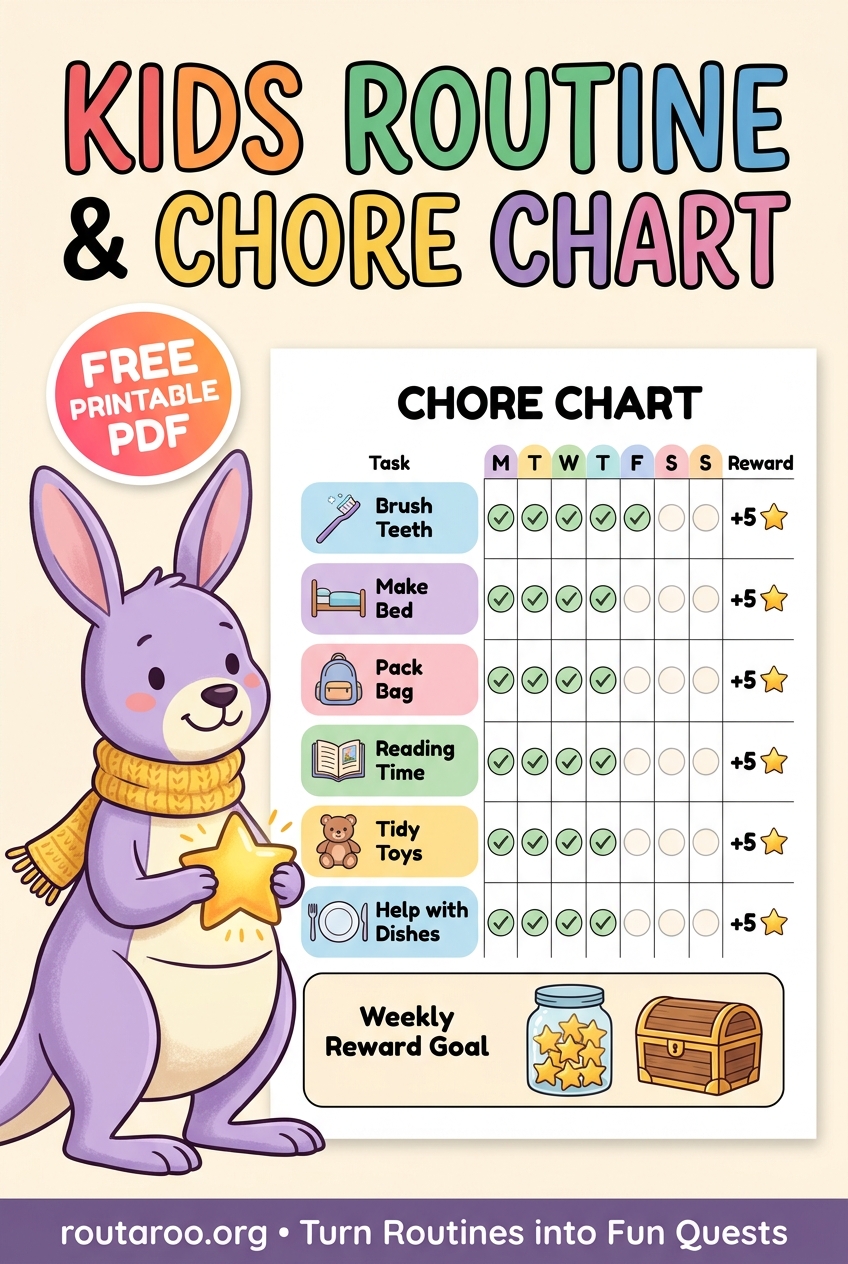
Need an Offline Anchor on Your Fridge?
Download our free 7-Day Illustrated Chore & Routine Chart! When responsibilities are clearly displayed on paper, kids know exactly what needs to be checked off before asking for screen time.
Download Free Printable Chore Chart (PDF) ↗ 100% Free • Print at Home • A4 & US LetterThe 4 Golden Rules That Eliminate Screen Meltdowns
If you want to stop screaming matches forever, put these four house rules in place starting today:
The “When / Then” Sequence (Privileges Follow Effort)
Never let screen time happen first thing in the morning or immediately upon walking through the door after school. When screens come first, transitioning to homework or chores feels like cruel punishment.
Use the unbreakable formula: “WHEN your afternoon quests are finished (shoes away, snack eaten, homework in backpack), THEN you unlock 45 minutes of game time.” The child holds the key to their own fun.
Build the “5-Minute Transition Bridge”
Shouting “TURN IT OFF RIGHT NOW!” from another room guarantees an explosion. Instead, physically walk over into their space 5 minutes before time expires:
- Join their world for 60 seconds: Look at their screen and ask: “Whoa, what are you building? Cool!” This pulls them out of the trance gently.
- Give a concrete stopping cue: “You have 5 minutes left. Find a good spot to save your world and finish this round.”
- Offer a tactile landing activity: Have a sensory bridge ready (a crunchy snack, peeling a clementine, petting the dog, or a silly joke). Don't transition straight from high-dopamine gaming into boring chore work.
Establish Sacred “Screen-Free Zones and Times”
Clear geographic boundaries prevent constant debates:
- The Family Dinner Table: Zero phones, tablets, or TVs during mealtime. Mealtime is reserved for real conversation and connection.
- Bedrooms Overnight: Screens emit blue light that suppresses melatonin production by up to 88% in young eyes. Charge all electronics overnight in the hallway or kitchen.
- Car Rides Under 20 Minutes: Use short trips for listening to audiobooks, playing 20 Questions, or simply daydreaming out the window.
Turn Screen Minutes into Star Tokens (No More Timer Anxiety)
Watching an arbitrary digital kitchen timer creates severe countdown anxiety for children. Instead of fighting over minutes, gamify their daily contributions!
In our family companion app Routaroo, kids complete daily offline tasks—brushing teeth, making their bed, feeding the pet—to earn glowing Star Tokens. Parents approve the quests, and children redeem their stars for agreed privileges, such as 30 minutes of tablet play, a board game tournament, or a weekend family bike ride.
Why Routaroo Replaces Screen Obsession with Real Habits
Unlike adult habit apps that lock kids in front of more screens with addictive streaks and micro-transactions, Routaroo is designed with zero manipulative mechanics. Kids check off physical quests in seconds, hand the device back to parents for star verification, and stay focused on real life.
Available on Google Play with no third-party ads.
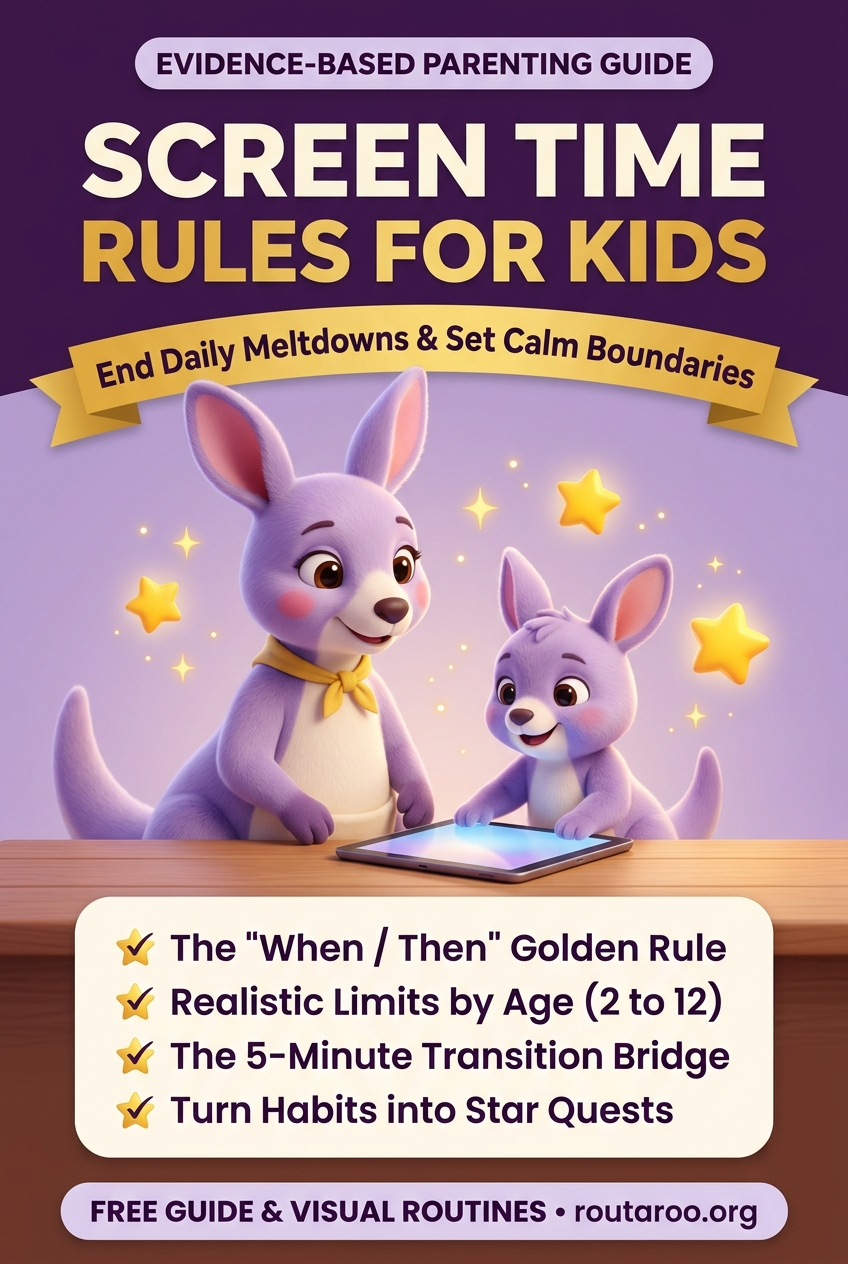
Save This Guide to Your Parenting Board!
Pin this visual summary to Pinterest so you always have the 4 Golden Rules and the 5-Minute Transition Bridge on hand whenever screen negotiations start.
✦ Tap & save to PinterestWhat to Do When a Meltdown is Already Happening (3 Emergency Steps)
If your child is already in the middle of a full-blown screen withdrawal tantrum, do not try to reason with them. Their thinking brain is temporarily offline. Follow these three emergency steps:
- Drop Your Voice to a Whisper: When a child screams, parents naturally elevate their volume. Counteract this by speaking softly and lowering your posture to eye level. A calm, quiet voice signals safety to an overwhelmed nervous system.
- Validate the Disappointment (Without Changing the Rule): Say: “I know. It really stinks having to turn it off when you were having so much fun. I'd be sad too. But screen time is all done for today.” You can hold the boundary firmly with love.
- Offer Proprioceptive “Heavy Work”: A physical sensory shift resets brain chemistry fast. Offer a deep bear hug, ask them to push against your hands with all their strength, or hand them a glass of ice-cold water to drink through a straw.
Frequently Asked Questions from Parents
Why does my child have an extreme meltdown every time the iPad turns off?
Screen activities—especially fast-paced video games and videos—trigger continuous dopamine release in the brain's reward center. When the screen is abruptly turned off, dopamine levels drop sharply. To a child's still-developing prefrontal cortex, this sudden neurochemical crash feels like physical distress. It is an involuntary emotional shock rather than deliberate defiance.
How much screen time is realistic for elementary kids on school days?
Most pediatricians and child development experts recommend keeping recreational entertainment screen time to roughly 1 to 1.5 hours on school days. More importantly, screen time should happen only AFTER core physical movement, homework, family dinner, and daily routine quests have been completed (the “When/Then” rule).
Should I take away screen time as a punishment when my child acts out?
Punitive screen removal often backfires by increasing resentment and desperation around digital devices. Instead of using screens as a weapon, frame screen privileges as a predictable outcome of effort: kids earn star tokens by completing their daily responsibility quests, and they choose when to budget their stars for parent-verified screen sessions.
How can I handle older kids needing laptops for homework while younger siblings demand games?
Clearly distinguish between “Tool Screens” (typing an essay, school research, family video calls) and “Toy Screens” (Minecraft, YouTube, mobile games). Keep school laptops in communal spaces like the kitchen counter with gaming sites restricted, and offer younger siblings an engaging offline quest or sensory activity during study hours.