
It is 7:42 AM on a Tuesday. You have already asked your seven-year-old four separate times to put on their shoes.
When you walk into their bedroom, you expect to find them tying their laces. Instead, they are sitting cross-legged on the rug in their pajamas, holding one sock in their left hand, completely mesmerized by a microscopic speck of lint on the baseboard.
Your blood pressure spikes. The familiar panic sets in: the school bell rings in twenty minutes, your work meeting starts at 8:30, and you hear that exhausted voice in your head saying: “Why do I have to say everything ten times? Why won't they just listen?”
If this scene plays out in your house every morning, take a deep breath. Your child is not trying to defy you, and you are not a bad parent.
What you are experiencing is not a discipline problem. It is an executive function bottleneck. And once you replace spoken auditory nagging with an external, low-friction visual schedule, everything shifts.
The Neuroscience of the “Broken Record”: Why Spoken Words Evaporate
To understand why visual schedules work miracles for neurodivergent children, we have to look inside the developing brain's working memory.
Think of working memory as an invisible desktop inside your child's head. When you tell a neurotypical ten-year-old: “Go upstairs, put your dirty laundry in the hamper, and bring down your math binder,” their brain clips that instruction onto their mental desktop, carries it upstairs, and executes it.
In a child with ADHD, autism, or executive function delays, that mental desktop is the size of a postage stamp—and someone has a high-speed fan blowing across it.
- Spoken words are temporal: Spoken soundwaves vanish the instant they leave your mouth. Once you stop talking, the reminder exists solely in their volatile working memory buffer.
- Sensory distraction overwrites working memory: On the walk upstairs, your child sees the cat, hears the refrigerator hum, or spots a Lego brick. That tiny sensory spark instantly purges the auditory instruction from their brain.
- Auditory processing fatigue triggers shutdown: When a child is repeatedly bombarded with auditory cues (“Hurry up!” “Shoes!” “Did you brush?”), their sensory system treats the sound as white noise or becomes overwhelmed, leading to meltdowns or freezing.
A visual schedule solves this fundamental neurological breakdown by turning temporary sound into a permanent spatial anchor. The schedule never blinks, never forgets, and never raises its voice.
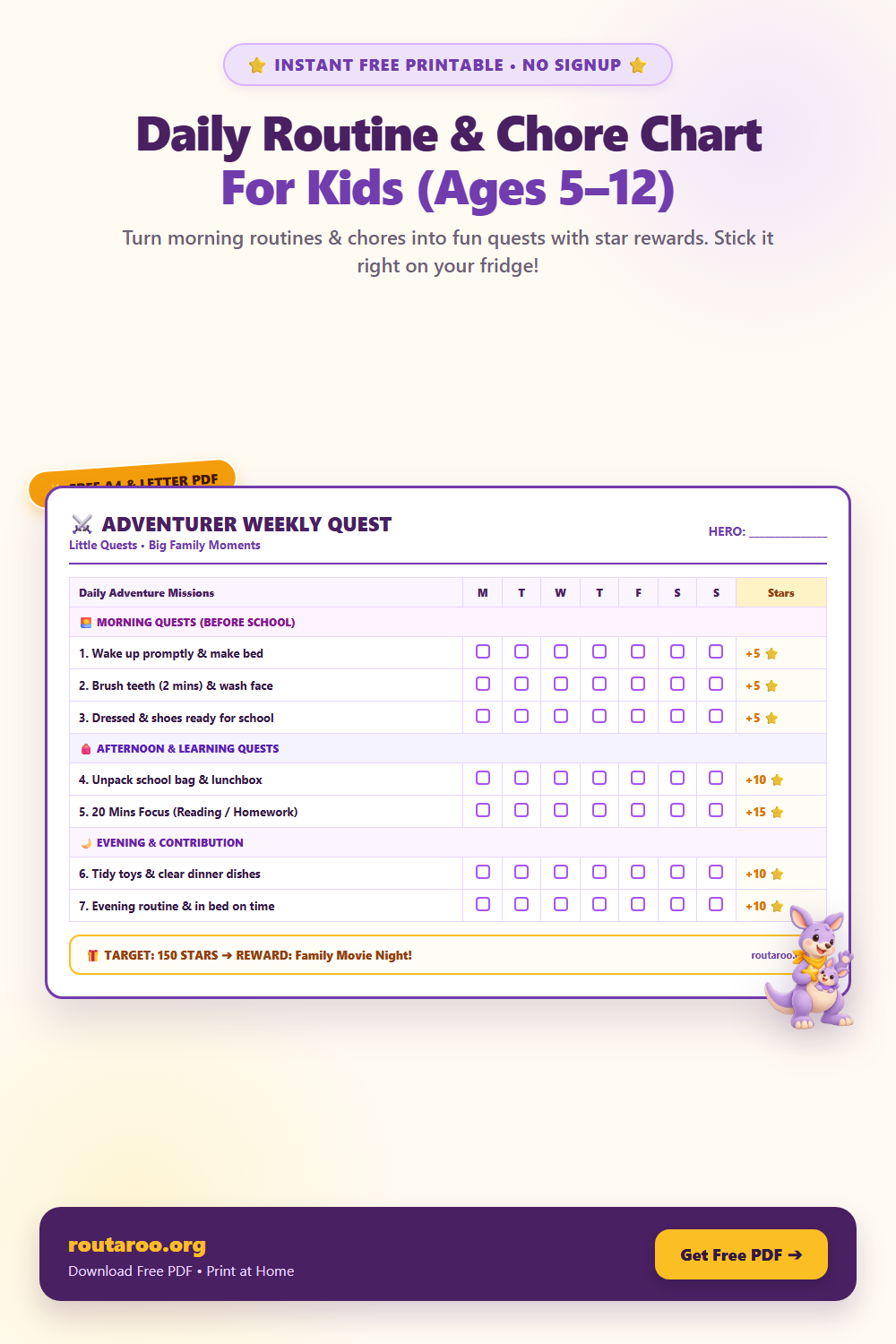
We created a free, beautifully illustrated 7-day visual routine checklist designed specifically for ADHD and visual learners. Download the high-resolution PDF for free and hang it on the fridge today:
Download Free Printable Visual Chore Chart (PDF) → 100% Free • A4 & US Letter • No sign-up requiredThe 4 Golden Rules of an ADHD-Friendly Visual Schedule
Many well-meaning parents create a giant Pinterest-style chart with 20 items, only to watch their child ignore it after 48 hours. Why? Because complex charts trigger executive overload.
To make a visual schedule stick, follow these four pediatric occupational therapy principles:
The “Rule of Three” (Chunking Over The Wall of Doom)
Never present a child with an all-day 15-step schedule at once. That looks like climbing Mount Everest. Instead, break the day into three isolated, digestible routine phases:
- Morning Launch: 3 or 4 essential quests only (Get dressed • Eat breakfast • Brush teeth • Backpack ready).
- After-School Landing: 3 transition quests (Shoes in basket • Snack eaten • Homework folder unpacked).
- Bedtime Wind-Down: 3 calming quests (Pajamas on • Dirty clothes in hamper • Bedtime story).
Use High-Contrast Visuals & Icons (Not Walls of Text)
For a distracted brain, decoding a paragraph of handwriting takes real mental effort. Visual icons, colorful badges, or photos of your child actually doing the task bypass the cognitive strain of reading.
When your child sees an icon of a toothbrush or a glowing backpack badge, their visual cortex processes the concept in under 100 milliseconds without triggering executive resistance.
Provide a Tactile Dopamine Loop (The Check-Off Ritual)
ADHD brains operate on a persistent baseline dopamine deficit. Telling them “good job” five minutes later does not provide immediate reinforcement.
Give your child a physical or interactive way to close each loop: moving a magnet from “To Do” to “Done”, sliding a wooden flap, or tapping an interactive quest card in an app that produces an immediate star chime. That micro-hit of satisfaction fuels them to tackle the next task.
The “When / Then” Sequence (Natural Motivation)
Never turn routine tasks into high-stakes arguments. Instead, tie the completion of the visual phase directly to the child's natural privileges:
“WHEN your three morning quests are verified on your board, THEN you unlock 20 minutes of Lego building before we leave for school.” The schedule holds the boundary; you are simply the supportive coach.
Age-by-Age Guide: What Visual Schedules Look Like in Practice
A visual routine must evolve as your child grows. Here is how to adapt visual schedules across three key developmental stages:
The “First / Then” Picture Strip
Young children cannot conceptualize linear time. Avoid clocks and timestamps. Use simple picture cards showing the immediate sequence.
- Morning Phase: 1. Potty • 2. Clothes on • 3. Breakfast.
- Bedtime Phase: 1. Bath • 2. Brush teeth • 3. Snuggle with book.
The Daily Quest Board with Star Currency
At this stage, school expectations increase dramatically (packing folders, remembering library books, unpacking lunchboxes). Introducing gamified quest framing works wonders.
- Morning Quests: Bed smoothed • Dressed • Teeth brushed • Water bottle filled.
- After-School Quests: Lunchbox to sink • Shoes to rack • 15 min reading quest.
- Evening Quests: Dirty clothes in basket • Quests verified • Lights out on time.
Autonomous Checklists & Executive Ownership
Tweens rebel against feeling micromanaged, yet their executive function is still maturing. Transition them from “mom's chart” to an autonomous personal checklist.
- Daily Focus: Device homework check • Sports gear packed • Pet care duty • Bedroom floor cleared.
- Weekly Reset: Bedding change • School backpack declutter • Star bank budgeting.
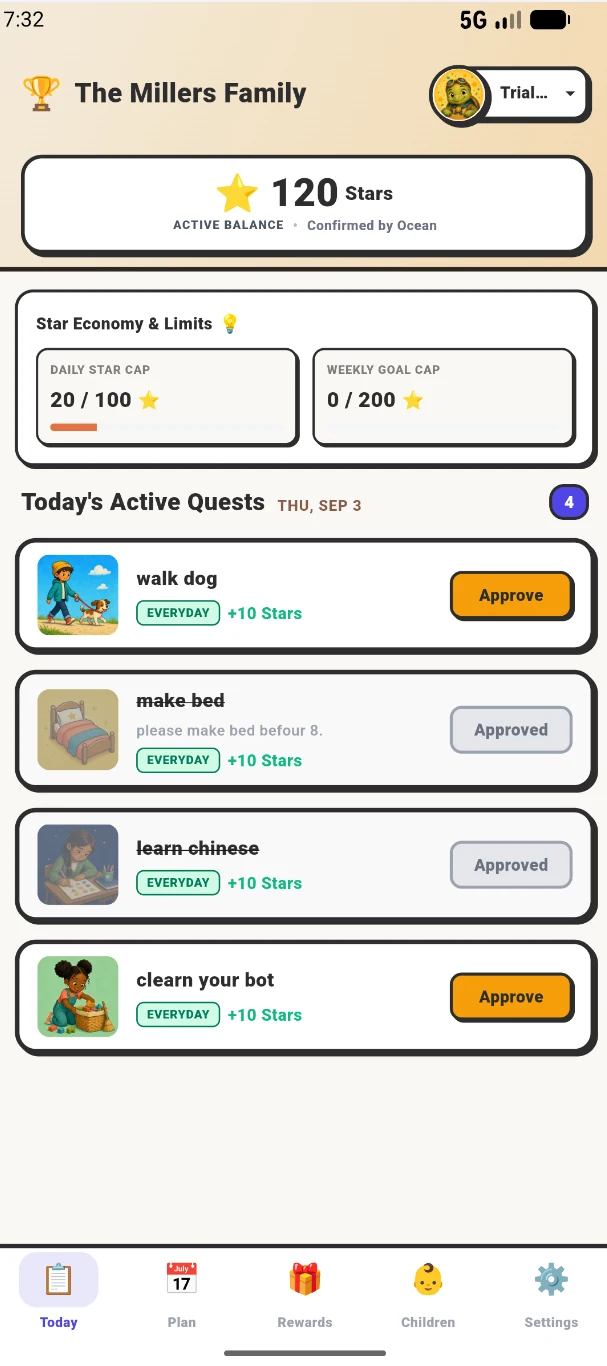
Turn Daily Routines into Calm Quests with Routaroo
Save This ADHD Routine Guide to Your Parenting Board!
Pin this visual summary so you always have the 4 Golden Rules and age-by-age routine blueprints when school mornings get chaotic.
✦ Tap & save to PinterestTroubleshooting: What to Do When They Ignore the Schedule
Even with the most beautiful visual schedule, there will be days when your child seems to walk right past it. Here is how to reset without yelling:
- Never Ask “Did you do your chores?”: This question invites immediate defensive lying or defensiveness. Instead, point gently toward the board and ask: “What does your quest board say is your next step?” This transfers authority to the neutral visual tool.
- Use “Body Doubling” for Hard Transitions: For ADHD children, starting a task from a standstill feels excruciating. Try body doubling: simply stand in the doorway of their room or fold laundry nearby while they get dressed. Your calm presence acts as a cognitive stabilizer.
- Reward Progress Over Perfection: If your child completed 3 out of 4 quests before 8:00 AM, celebrate those 3 wins! An all-or-nothing mindset causes children with executive challenges to give up entirely. Every small completed quest builds neurological confidence.
Frequently Asked Questions from Parents
Why do spoken reminders not work for children with ADHD?
Children with ADHD and executive dysfunction experience developmental lags in auditory working memory. When a parent rattles off a multi-step command (“Brush your teeth, put your socks on, and grab your backpack”), the instruction vanishes from their working memory within 10 to 15 seconds. Spoken words are temporary and invisible, whereas a visual schedule remains permanently anchored in their physical environment as an external memory prosthetic.
What is the best visual schedule format for an easily distracted child?
Simplicity and minimalism are essential. Avoid giant wall charts with 25 different chores, which trigger immediate cognitive overwhelm. The most effective ADHD format is a 3-to-4 item linear checklist showing only the immediate routine phase (Morning Quests, After-School Focus, or Bedtime Routine). Clear icons or photos, paired with an interactive tactile mechanism (moving a magnet, sliding a flap, or tapping complete in an app), keep motivation high without sensory overload.
How do I get my child to actually look at their schedule without nagging them?
Instead of commanding your child (“Go look at your schedule!”), ask curious guiding questions that place ownership on the board: “What does your quest board say is next?” Pair completion with the “When/Then” principle: “WHEN your three morning quests are verified on your board, THEN you unlock free playtime or your morning story.” This shifts the parent from being a nagging police officer into a supportive coach celebrating their child's progress.
Should I use a physical printable chart or a digital routine app for ADHD?
Both have distinct strengths, and many families achieve the best results by using both in tandem. A physical printable chart on the refrigerator or bathroom mirror provides an unmissable tactile anchor in the home. Meanwhile, a purpose-built digital companion like Routaroo turns daily routines into bite-sized quest cards without countdown timer stress, punitive streaks, or distracting ads—allowing kids to earn glowing star tokens and redeem them for parent-approved family rewards.
Explore More Peaceful Parenting Guides
- How to Stop Morning Routine Battles with Kids (Without Yelling)
- Age-Appropriate Chores for Kids: The Realistic Mom's Guide (Ages 2 to 12)
- Screen Time Rules for Kids: How to Set Calm Boundaries (Without Tantrums)
- How to Teach Kids About Money Using Chores & Simple Allowance Systems
- Bedtime Routine Checklist for Kids: End the 100 Stalling Excuses
- Star Reward Chart for Kids: How to Motivate Cooperation Without Bribes
- How to Get Kids to Clean Up Toys Without Screaming (Fun 5-Minute Games)
- Back-to-School Morning Checklist: 4 Habits for Calm, On-Time Mornings
- Positive Reinforcement for Kids: What to Say Instead of “Good Job!”
- ADHD Morning Routine for Kids: 7 Strategies That Actually Work
- Free Printable 7-Day Visual Chore Chart (PDF)