
It is a scene nearly every parent knows by heart: you are standing at the grocery store checkout or walking past the toy section, and your child spots a glittering plastic gadget, a box of blind-bag figurines, or an overpriced lollipop.
“Can I get this? Please? Just this once! You never buy me anything!”
When you say no, tension flares. You might try explaining: “Money doesn’t grow on trees,” or “Do you know how hard Mommy works for twenty dollars?” But those words rarely register. To a 6-year-old in a world of invisible tap-to-pay smartphones and magic plastic cards, money feels infinite. Things simply appear when grown-ups swipe their phone.
Teaching children the true value of money is one of the greatest gifts parents can offer. Yet traditional approaches often plunge families into frustration: paying kids for every basic chore creates entitled little negotiators who refuse to pick up their socks without a dollar in return, while handing out cash without structure leads to lost coins and forgotten lessons.
In this comprehensive guide, we will unpack the pediatric and financial consensus on kids and money: how much allowance to give by age, how to separate household chores from financial literacy, and how a visual token system like Routaroo stars builds delayed gratification without yelling or emotional bribes.
The Dangerous Chore-for-Pay Trap (And Why Paying for Bed-Making Backfires)
When parents decide to introduce an allowance, their first instinct is usually: “I’ll pay them for doing their chores! Fifty cents to make the bed, fifty cents to brush teeth, a dollar to unload the dishwasher.”
It sounds logical, but pediatric behavioral researchers and family therapists strongly discourage this model. Here is what happens in practice:
- The “I’m Rich Enough” Rebellion: Within three weeks, your child has saved $15 from their birthday or grandparents. On Tuesday morning you tell them to make their bed. Their response? “Nah, I don’t need any money today, so I won’t do it.” By commodifying basic responsibility, you lose parental authority over household cooperation.
- Erosion of Family Citizenship: Families are teams, not commercial corporations. Nobody pays Mom or Dad to wipe the kitchen counters or make dinner. When children expect cash compensation for picking up their own jackets or putting dirty dishes in the sink, they miss out on learning intrinsic communal responsibility.
- Administrative Burnout: Tracking twenty micro-transactions across seven days turns parents into exhausted accountants constantly calculating nickel-and-dime deductions.
Instead of blending chores and money into a chaotic blend, the most successful families adopt the Three-Tier Responsibility Framework:
Tier 1: Citizen Responsibilities
Unpaid • Expected as a Family Member
These are baseline self-care routines and shared living duties. Done because we love and respect our shared home.
- Making own bed
- Brushing teeth & getting dressed
- Putting dirty clothes into the hamper
- Clearing your own plate after dinner
- Putting away personal toys & backpack
Tier 2: Extra Contribution Quests
Paid or Star-Earning • Above & Beyond
Optional special tasks that genuinely lighten the family load beyond everyday room maintenance.
- Detailing the interior of the car
- Raking fallen leaves or pulling garden weeds
- Scrubbing bathroom tiles or baseboards
- Organizing the family pantry or shoe closet
- Washing outdoor porch windows
Tier 3 is the Learning Allowance itself: a consistent, modest weekly amount given purely as an educational instrument. Your child receives this baseline not as a reward for breathing, but because they need real currency (or effort tokens) to practice saving, budgeting, and giving.
Before introducing money, establish calm daily habits first. Download our free, beautifully illustrated 7-day visual routine checklist to anchor morning and bedtime self-care on your refrigerator:
Download Free Printable Visual Chore Chart (PDF) → 100% Free • A4 & US Letter • No sign-up requiredHow Much Allowance for Kids by Age? (The Definitive Benchmark)
The most widely adopted guideline among financial educators and child psychologists is the Age-Based Rule of Thumb:
Weekly Allowance = $0.50 to $1.00 per year of your child’s age
Under this standard, an 8-year-old receives $4.00 to $8.00 per week, while a 12-year-old receives $6.00 to $12.00 per week. However, the exact dollar amount matters far less than what the money is expected to cover.
Here is how to structure money and allowance across each developmental stage:
Concrete Tokens & The Concept of Waiting
At this stage, paper bills and digital numbers are too abstract. Young children do not understand that a thin green piece of paper buys more than a shiny, heavy copper penny. What they do understand is delayed gratification: waiting until tomorrow to unlock something special.
- Recommended Weekly Amount: $1.00 to $2.00, or 5 to 10 Star Tokens in an app like Routaroo.
- Core Financial Lesson: Trade-offs. “If you want this dinosaur sticker pack, it costs 5 stars. Once you spend them, the stars are gone.”
- What They Pay For: Tiny discretionary treats (a 50-cent sticker sheet, extra story at bedtime, picking the park outing).
The 3-Jar System & Experiencing Regret Early
Elementary children understand simple math and begin to realize that things cost differing amounts. This is the golden window to introduce physical jars and let them make cheap mistakes.
- Recommended Weekly Amount: $4.00 to $8.00 per week (or $1 per year of age).
- Core Financial Lesson: Opportunity cost and the 3-Jar System (Spend, Save, Give). If they blow all their money on cheap plastic vending-machine junk on Monday, they have zero money for ice cream on Friday.
- What They Pay For: Collectible cards, small toy cars, slime, treats outside normal family snacks.
Milestone Goal Budgeting & Brand Differences
Pre-teens face intensifying peer influence and brand awareness. They notice who has specific sneakers, video game skins, and trendy accessories. Allowance at this stage should teach the difference between parent-funded essentials and kid-funded upgrades.
- Recommended Weekly Amount: $8.00 to $12.00 per week.
- Core Financial Lesson: Long-term saving goals and matching funds. If your child wants a $60 video game or sports gear, agree to match 50% once they save their first $30.
- What They Pay For: Video game cosmetics (Robux, V-Bucks), movie outings with friends, snacks at school sporting events, trendy brand premiums above basic shoes or backpacks.
Real-World Autonomy & Digital Money Management
High schoolers are preparing for independent adult life. Micro-allowances given in weekly dollar bills become obsolete. Instead, transition teenagers to a monthly clothing and personal entertainment budget managed through a student debit card.
- Recommended Weekly Amount: $15.00 to $30.00 per week, or a $75–$120 monthly stipend.
- Core Financial Lesson: Cash flow pacing. If they spend their entire monthly clothing allowance during the first weekend, they must wait until the 1st of next month to buy anything else. No emergency parent bailouts.
- What They Pay For: Fast food with friends, personal wardrobe choices beyond essentials, personal streaming subscriptions, gasoline for family car use.
The 3-Jar System: Spend, Save, Give (The 70 / 20 / 10 Framework)
When an allowance is dumped entirely into a child’s wallet, it almost always disappears immediately. To teach balanced financial health, use the time-tested 3-Jar System (or three digital categories).
Every time allowance is distributed or star rewards are banked, divide the total according to the 70 / 20 / 10 principle:
The Spend Jar (Immediate Autonomy & Freedom)
This is your child’s personal discretionary fund. They can spend it on whatever harmless items they desire: stickers, comic books, trading cards, or candy.
The golden parent rule: You cannot veto purchases from the Spend jar unless they are dangerous or illegal. If you forbid them from buying goofy slime or cheap trinkets with their own money, they never learn the personal consequence of spending decisions.
The Save Jar (Delayed Gratification & Milestones)
Money placed in the Save jar cannot be spent on impulse impulse buys. It is earmarked for milestone targets that require three to eight weeks of consistent patience: a scooter, a Lego set, or tickets to an amusement park.
Tape a picture of their target goal directly onto the front of the Save jar (or select it as a goal in the Routaroo Family Reward Shop). Visualizing the finish line keeps motivation alive when temptation strikes.
The Give Jar (Empathy & Community Connection)
Generosity is an emotional muscle that must be exercised early. Ten percent of their allowance goes toward causes they care about: buying pet food for the local animal rescue, picking out a toy for a holiday charity drive, or buying a birthday gift for a sibling.
Let them physically place the donation or choose the charity. Seeing the direct positive impact of their money cultivates gratitude and perspective.
The “Wishlist Protocol”: How to End In-Store Tantrums for Good
The next time your child clutches a shiny toy in a store aisle and begs you to buy it, do not engage in a heated debate over whether they “deserve” it. Instead, employ the Wishlist Protocol:
- Validate their excitement: “Wow, that robot looks awesome! I can totally see why you love the glowing wheels.”
- Take out your smartphone: “Let’s take a clear picture of it and add it directly to your Official Birthday & Goal Wishlist!” (Nine times out of ten, taking the photo satisfies the emotional desire to feel seen and heard).
- Check their Spend balance: “This robot costs $24. You have $8 in your Spend jar right now. If you really want it, you can save your Spend allowance for the next three weeks, or do you want to keep saving for your Lego set?”
Notice what happened: you did not shout, you did not say “We can’t afford that!”, and you did not play the villain. You placed the financial choice entirely in their hands. They either choose to save for it, or they realize within two days that they did not really care about the robot after all.
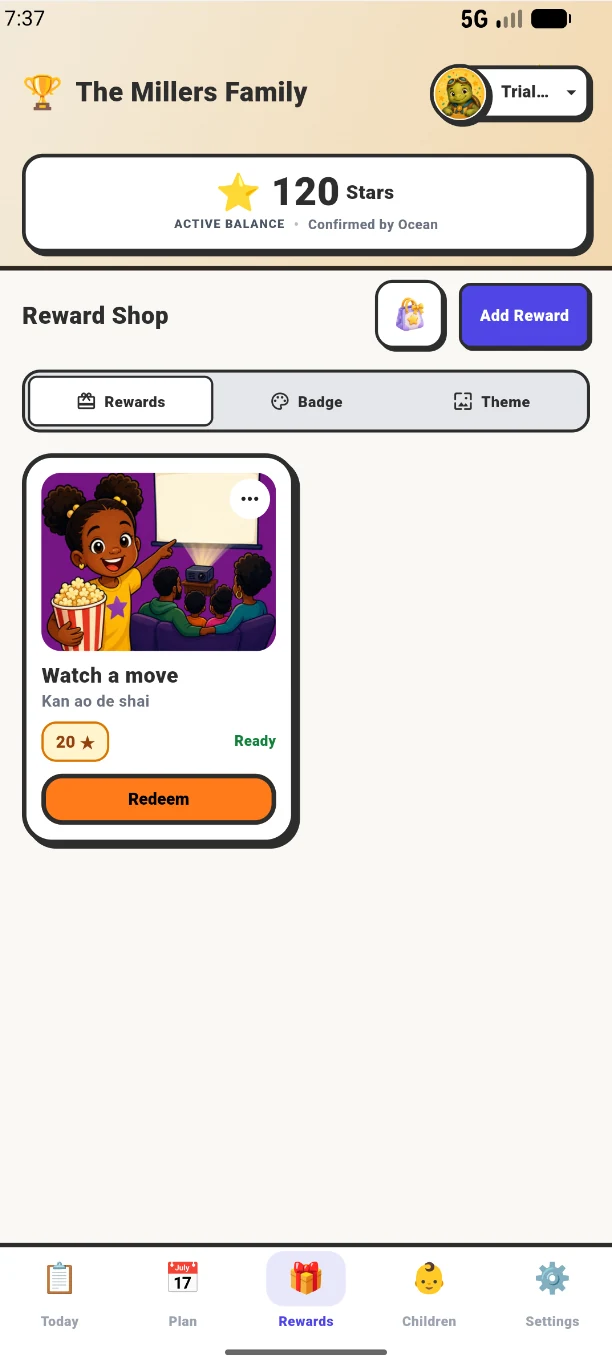
Build Healthy Financial Habits with the Routaroo Star Economy
5 Common Allowance Mistakes Parents Make (And How to Fix Them)
Even the best allowance intentions can run off course without consistent boundaries. Watch out for these five frequent pitfalls:
Using Allowance as a Disciplinary Fine
When a child has a meltdown, talks back, or forgets their homework, frustrated parents often yell: “That is $2 off your allowance this week!”
The fix: Keep discipline and financial literacy separate. Fining kids breeds resentment, teaches them that bad behavior can simply be paid off, and ruins the predictability needed for budgeting. Deal with behavioral issues through natural consequences (earlier bedtime, losing screen privileges, or making restorative amends).
Bailing Them Out When They Go Broke
Your child spends all their allowance on a Tuesday and then begs for an ice cream cone on Thursday. Feeling guilty, you buy it anyway.
The fix: Stand comfortably in the discomfort. Empathize with warmth: “I know, it’s hard to wait until allowance day. You’ll have fresh money on Sunday!” If you always rescue them, they learn that bank accounts have invisible safety nets.
Inconsistent Allowance Days
Forgetting allowance day for three weeks, then suddenly handing over a random $20 bill, ruins the opportunity to practice cash-flow pacing.
The fix: Pick a fixed “Payday” (such as Sunday evening during family routine reviews). If you use digital stars in Routaroo, the app tracks star approvals automatically so balances never get lost or forgotten.
Over-Polishing and Micromanaging Their Choices
If you dictate every purchase your child makes from their Spend jar (“No, you can’t buy that bouncy ball, that’s a waste of money”), it is not truly their allowance—it is just your money with extra steps.
The fix: Step back. As long as the purchase is safe and ethical, let them buy the silly novelty item. Realizing they wasted their own money on useless junk is the most profound consumer lesson they can learn.
Waiting Too Long to Start
Many parents wait until their children are teenagers to talk about money. But research from Cambridge University shows that money habits and delay-of-gratification instincts are largely formed by age 7.
The fix: Start early with visual tokens, stars, and concrete jars. Even a 4-year-old can understand saving three stars for a weekend bike ride with Mom.
Frequently Asked Questions About Kids, Chores & Allowance
How much allowance should I give my child by age?
The standard guideline recommended by pediatric financial experts is $0.50 to $1.00 per year of age per week (e.g., $3 to $6 for a 6-year-old; $5 to $10 for a 10-year-old). For toddlers and preschoolers (ages 3 to 5), an effort-based token system like Routaroo stars (5 to 10 stars weekly) provides a tangible, visual bridge before introducing physical bills.
Should chores be tied to allowance or kept separate?
Child development specialists recommend separating basic citizen chores from allowance. When everyday duties (like making beds or brushing teeth) are paid, children may refuse to cooperate whenever they do not need money. Keep baseline routines unpaid as part of family teamwork, and offer optional extra contribution quests (like washing the car or weeding the garden) for children who want to earn additional income.
At what age should parents start an allowance?
Most children are ready for a structured cash allowance around ages 5 to 6, when basic arithmetic and an understanding of exchange value develop. Younger children (ages 3 to 4) benefit most from a visual token economy where effort stars are saved and redeemed for shared family experiences.
What is the 3-jar money system for kids?
The 3-jar framework divides all incoming funds into Spend (70% for immediate wants), Save (20% for milestone goals requiring weeks of patience), and Give (10% for charity and gifts). This simple structure instills balanced financial habits, prevents impulse splurges, and nurtures lifelong generosity.
Should parents dock or deduct allowance as punishment?
No. Fining children for behavioral issues or emotional outbursts weaponizes money and undermines its role as a neutral educational tool. Address misbehavior through logical, related consequences (such as loss of screen time or restorative chores) rather than financial deductions.
Explore More Peaceful Parenting Guides
- How to Stop Morning Routine Battles with Kids (Without Yelling)
- Age-Appropriate Chores for Kids: The Realistic Mom's Guide (Ages 2 to 12)
- Screen Time Rules for Kids: How to Set Calm Boundaries (Without Tantrums)
- Visual Schedule for Kids: The ADHD-Friendly Guide to Peaceful Days
- Bedtime Routine Checklist for Kids: End the 100 Stalling Excuses
- Star Reward Chart for Kids: How to Motivate Cooperation Without Bribes
- How to Get Kids to Clean Up Toys Without Screaming (Fun 5-Minute Games)
- Back-to-School Morning Checklist: 4 Habits for Calm, On-Time Mornings
- Positive Reinforcement for Kids: What to Say Instead of “Good Job!”
- ADHD Morning Routine for Kids: 7 Strategies That Actually Work
- Free Printable 7-Day Visual Chore Chart (PDF)