
If you have ever found yourself standing by the front door holding a lukewarm mug of coffee while frantically repeating, “Shoes! Backpack! Have you brushed your teeth yet?!”, you are far from alone.
Morning routine battles are among the most exhausting friction points in modern family life. You start the day wanting calm connection, but within forty minutes, you are late for school, stress is peaking, and everyone leaves the house on edge.
The good news? Children do not resist mornings to be difficult. Once you understand the cognitive reality of how young brains experience time, you can shift from exhausting verbal reminders to an automatic, playful routine.
Why Do Morning Battles Happen? The Science Behind Friction
To solve morning battles, we first need to look at what is happening inside a child's brain between 7:00 AM and 8:00 AM:
- Executive Function is Still Under Construction: Skills like prioritizing tasks, sequencing steps, and resisting distractions do not mature until adulthood. Expecting a 6-year-old to self-manage four sequential tasks is asking a brain to do what it literally cannot yet coordinate alone.
- Time Blindness: Adults perceive the difference between 7:15 and 7:45 as urgent. Young children live purely in the present moment. “We have 10 minutes” is an abstract concept that feels meaningless to them.
- Transition Fatigue: Moving from warm beds and free play into high-demand adult schedules produces natural psychological resistance.
The 5-Step Visual Framework for Calm Mornings
Here is the step-by-step framework used by thousands of parents to replace morning chaos with predictable calm:
Replace Auditory Reminders with Visual Anchors
When you say, “Brush teeth, put on socks, find your lunchbox,” the information vanishes into thin air within seconds.
Visual schedules and checklists provide a permanent external anchor. When a child can look at an illustrated icon of a toothbrush or a backpack, they do not need to store the parent's instructions in their working memory. The chart becomes the boss, removing you from the role of nagging enforcer.
Stick to the “Core 4” Morning Quests
Overloading a morning checklist with ten different chores creates paralysis. Streamline your morning to four non-negotiable items:
- Dressed for the Day (Clothes picked the night before)
- Healthy Breakfast & Water
- Teeth Brushed & Face Washed
- Backpack & Shoes Ready by the Door
Everything else can wait until after school. Mastery of four core quests builds immediate momentum and pride.
Use the “When / Then” Golden Rule
Instead of threatening punishments (“If you don't put your shoes on right now, no playground this weekend!”), use positive conditional phrasing:
Try saying:
“WHEN your four morning quests are checked off, THEN you can have 15 minutes to build Lego / listen to your favorite audiobook in the car.”
This hands psychological control back to your child: if they choose to move quickly, they earn their enjoyable free time. The clock, not the parent, becomes the boundary.
Turn Tasks into Adventures with Star Rewards
Children are naturally wired for play, questing, and milestone achievements. When brushing teeth transforms into a “Little Quest” that awards a glowing star token, dopamine switches from resistance to engagement.
Accumulated stars can be redeemed for parent-approved family rewards: choosing Sunday morning pancakes, selecting the family movie, or unlocking extra playtime.
Do the 5-Minute Evening Reset
Eighty percent of morning success happens before your child goes to sleep. Spend five peaceful minutes before bed laying out tomorrow's clothes, ensuring homework is in the backpack, and setting the visual chart to ready. When mornings start without missing shoes or lost homework, emotional bandwidth remains intact.
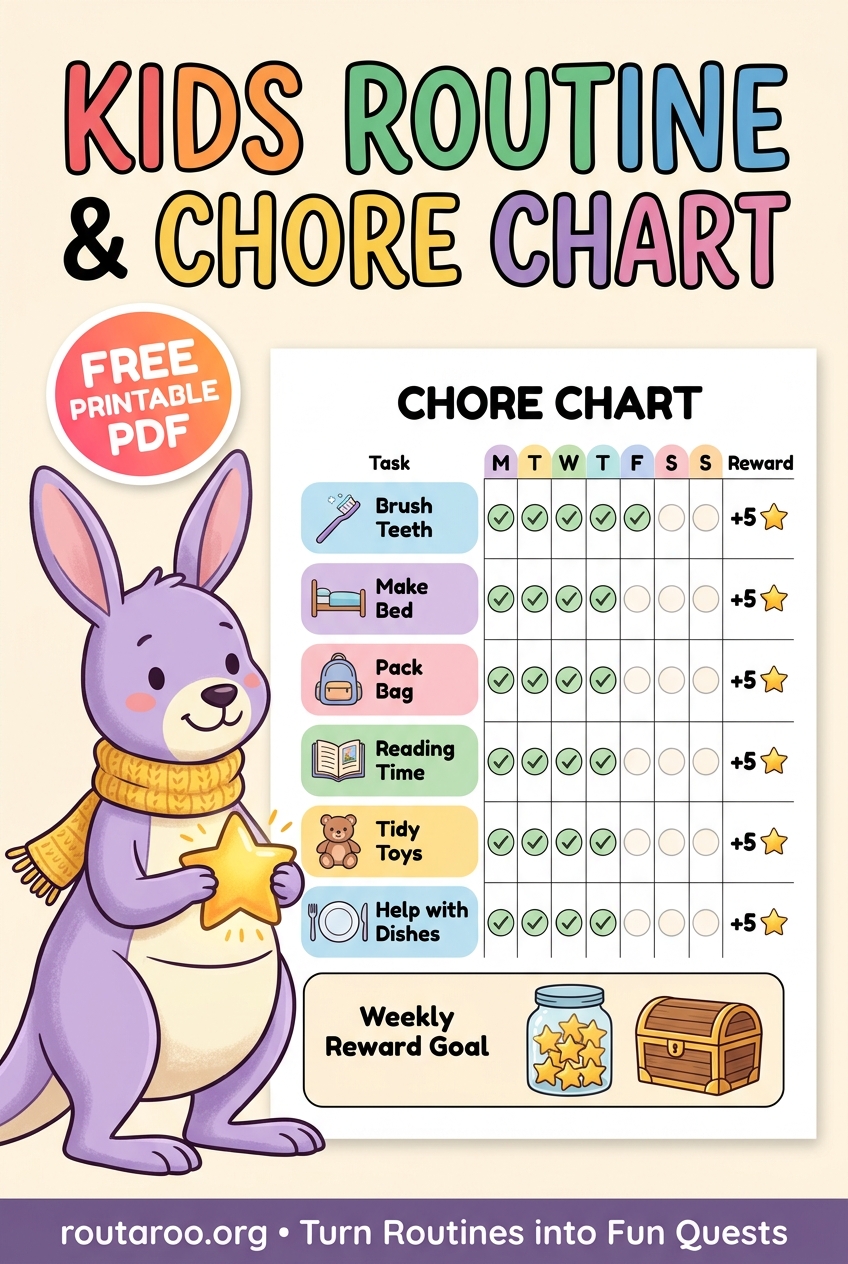
Want a Ready-to-Print Morning Checklist?
Download our free 7-day illustrated weekly chore & routine chart. Stick it on your fridge, let your kids check off their daily quests, and celebrate small wins together!
Get Free Printable Chore Chart (PDF) ↗ 100% Free • Instant A4 / US Letter DownloadReady to Level Up? From Paper to Digital Quests
Paper charts are an incredible starting point. But when tallying stars by hand gets messy, or your child wants audio celebration chimes and customizable character themes, a digital companion makes family habits effortless.
Frequently Asked Questions
What if my child has ADHD or sensory challenges with clothing/brushing?
Children with ADHD benefit immensely from visual checklists because working memory demands are offloaded onto the physical environment. For sensory sensitivities, involve your child in choosing seamless socks or flavored toothpaste beforehand so sensory friction does not trigger a fight.
What if my child refuses to do their morning tasks?
Stay calm and neutral. Do not argue or yell. Simply say: “The visual schedule is waiting for you whenever you are ready. As soon as quests are done, you unlock your morning free time.” Let the natural consequence of waiting do the teaching.
What age is this routine framework suitable for?
This visual framework works wonderfully for children aged 4 to 12. Younger children (ages 4–6) rely more on colorful pictorial icons, while older kids (ages 7–12) thrive on autonomy, managing their own star banks, and choosing meaningful weekly goals.